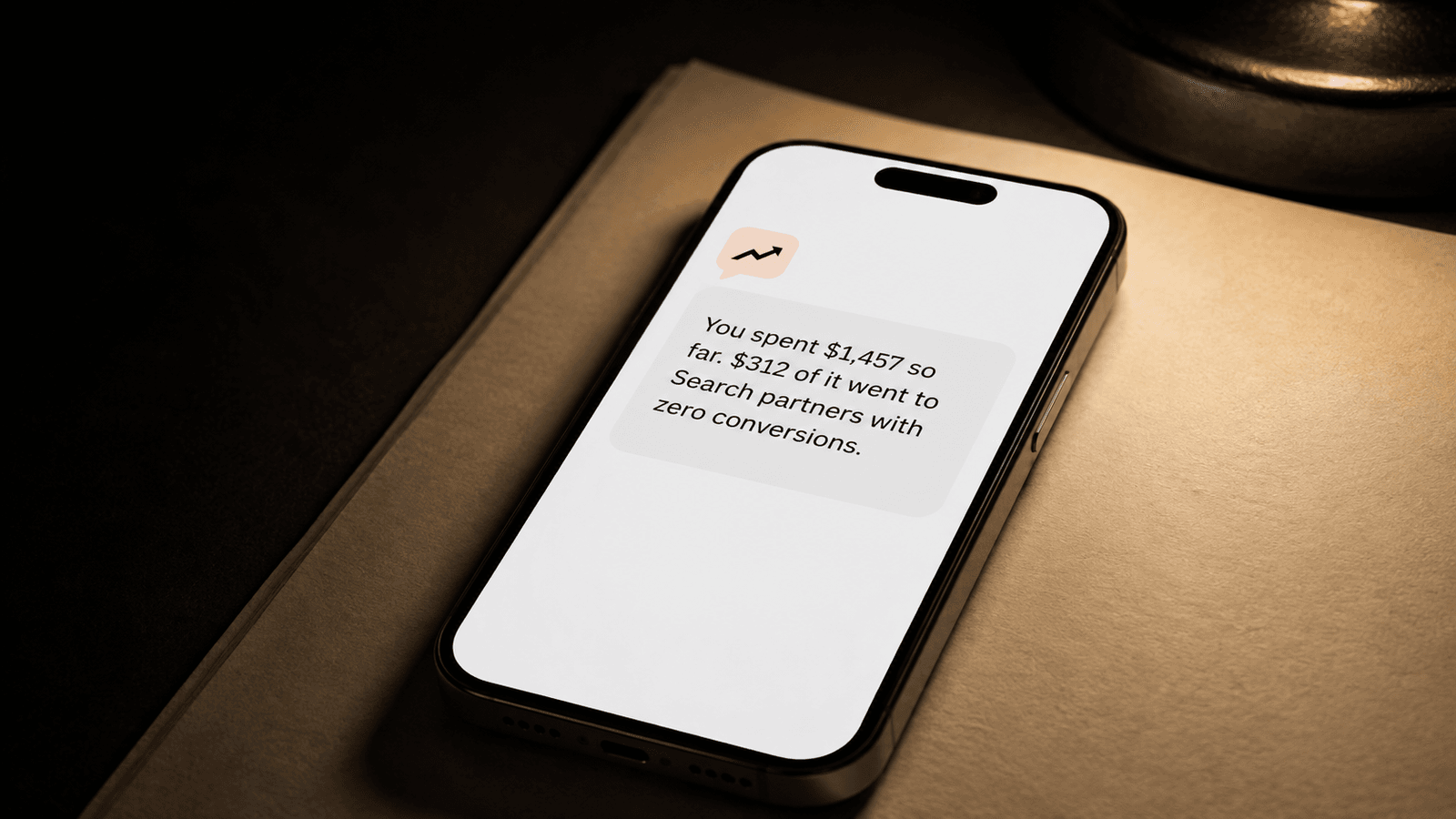
It is late, the shop is closed, and the question is not complicated. Money left the account this month. Where did it go, and did any of it come back?
That is the whole question. It is the one you would ask a friend who knew about this stuff, in one breath, without looking anything up. And it is the one question the tool you are paying does not answer in one breath.
The question you're actually asking
Owners ask about money in four shapes, and they are all the same shape.
- What did I spend, and on what?
- Which part of it brought nobody?
- What changed, and when?
- What would you do about it, and what is that worth?
Notice what is missing from that list: match types, attribution windows, impression share, optimization score. Nobody outside the industry has ever gone to bed worrying about their impression share. They worry about the four questions above, and the platform answers none of them in those words.
Why Google Ads can't just say it
Google Ads is a cockpit. Every dial in it exists for a reason, and every reason is a professional's reason. It is designed for people who fly it all day, and for them the density is a feature: nothing is hidden, everything is one click deep, the vocabulary is exact.
You are not flying it all day. You open it, you see forty numbers with names you half recognise, you close it. That is not a failure of attention. It is what a cockpit does to a passenger.
One more thing, said plainly. Google earns per click and a retainer scales with your budget, so neither has much reason to suggest spending less. The straight answer has to come from something that earns nothing when you spend more.
What a straight answer looks like
Here is a month from an example account we keep for exactly this purpose, so nothing here is a customer's private data. The account spends about forty-eight dollars a day on a small Search campaign. On the twelfth, a setting called Search partners was switched on, which sends your ads to a network of sites outside Google itself. From that day the account spent about twenty-four dollars a day more, and not one of those extra clicks turned into a lead. By the twenty-fourth the extra spend came to $312, illustrative, and still counting.
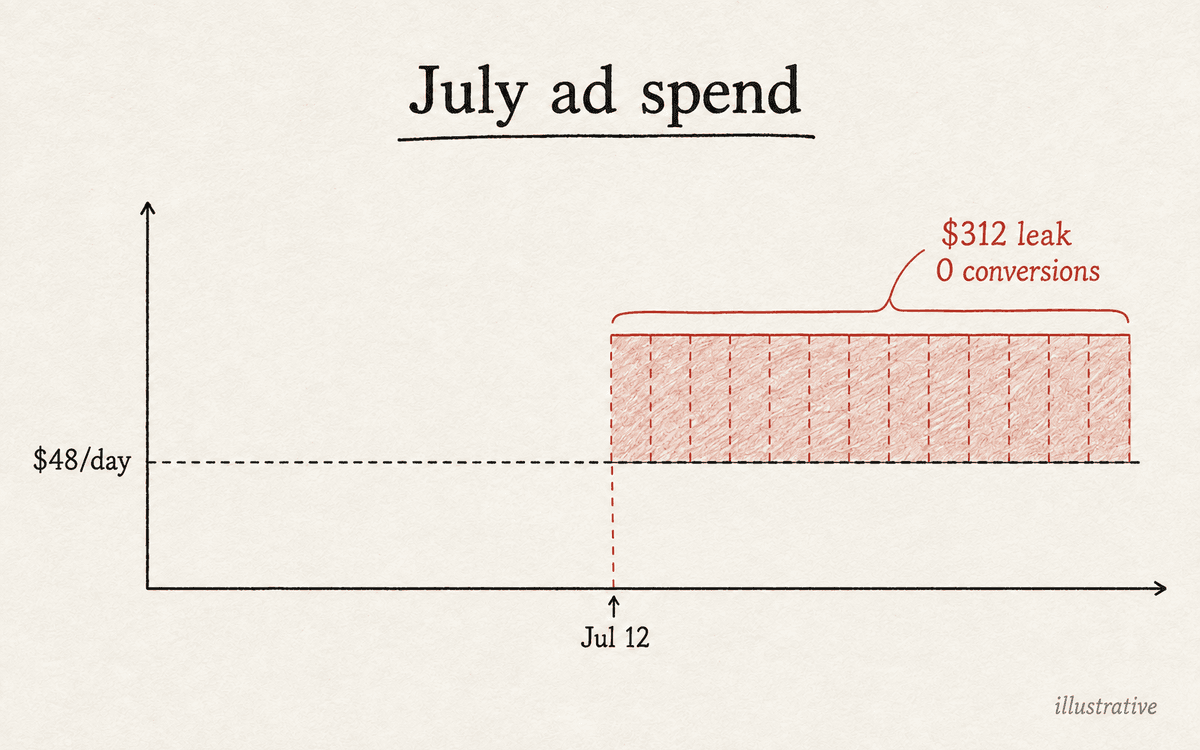
Now here is the same fact the way a person would say it: you spent $1,457 so far this month, and $312 of it went to Search partners with zero conversions, starting on the twelfth. Illustrative numbers, real shape. That sentence has a figure, a place, and a date. You can act on it. You can also argue with it, which is the other thing a real answer lets you do.
The difference between the cockpit and the sentence is not the data. It is the same data. The difference is that somebody did the reading for you and told you what it meant.
Seven questions worth asking your account
If you had someone to ask, these are the questions that pay for themselves. They are also, not by accident, the questions we built the product to answer.
- What did I spend this month, and on what? Not the total; the breakdown by campaign, in dollars, biggest first.
- Which search terms brought nobody? The exact phrases people typed that cost you a click and never became a call, a form, or a sale.
- Which campaign got worse this week, and by how much? "Worse" in your terms: more spent per lead, or fewer leads for the same money.
- Am I paying for clicks from places I don't deliver to? Geography is the leak nobody checks, because the default is "everywhere".
- What changed last Tuesday? Something did; spend jumped, or leads stopped. Ask for the change, not the chart.
- What would you pause first, and why? A ranked list is worth more than a dashboard.
- What is it worth if I fix it? The number that decides whether you bother.
You will notice none of these require you to know a match type from a bid strategy. They require the account to be read by someone who does, and reported back in your words.
Reading the answer without a degree
One phrase you will see on a scan from us: potentially avoidable, lower bound. It sounds hedged because it is, on purpose.
"Potentially avoidable" means the spend went somewhere with no evidence it came back: a search term that never converted, a network that never converted, a location you don't serve. It does not mean "definitely wasted", because a click can lead to a phone call nobody tracked. "Lower bound" means the figure is the least it could be. Overlapping problems are counted once, and anything the account cannot prove is left out rather than guessed. When the tracking is broken and the waste cannot be measured at all, the honest answer is a zero with a note saying why, not a made-up figure.
That is the difference between a number you can trust and a number that is there to impress you. A trustworthy number is smaller than the scary one, and it tells you what it does not know.
You don't have to learn the machine
The interface is not going to get simpler. You do not need to keep up with it. You need to be able to ask, at eleven at night, where the money went, and get a sentence back.
Ask it this month. Ask it last month. Ask what happened on Tuesday. Then, when you know, decide what to do about it, and do that part on your own terms, with your own yes.