You have had the audit. Maybe an agency did it as a pitch, maybe a tool did it for free, maybe a friend who "knows ads" spent an hour in your account. It found things. Broad match keywords bleeding into nonsense. Search partners on. A campaign targeting the whole planet when you deliver to two counties. A budget that never moved.
And then it ended the way every audit ends: a list, a few "you should probably…", and a door closing. You are back in the account, alone, and now you know exactly what you are ignoring.
Every audit ends the same way
An audit is a diagnosis. It is a valuable one, and the people who do them well earn their fee. But a diagnosis with no hand on the wheel leaves you holding a piece of paper in front of a machine you are afraid of.
The list says "pause the broad match keywords". Fine. Which of the eleven? All of them? What happens to the campaign that is currently paying your rent if you pause the wrong one? The list does not say, because the list was never going to be there when you clicked.
Tools are the same, only faster. They check the settings that every account has, produce the same twenty findings, score you out of a hundred, and leave. The score is not for you. It is for the person who wants to sell you the fix.
Why nobody touches the account
One wrong click in Google Ads can pause the campaign that pays the rent. Everyone who has run their own ads knows this in their body. So the account gets treated like a fuse box: you open the door, you look at it, you close the door.
Meanwhile the waste keeps running. It is the quietest kind of loss, because nothing breaks. The bill arrives, it is about what it was last month, and nobody can point to the part that bought nothing.
This is the problem an audit does not solve, and cannot, because it is not a knowledge problem. You know the broad match keywords are leaking. You are afraid of the fix.
What a finding with a fix button is
Here is what we decided a finding should be, and it is a product decision, not a feature.
A finding names the money. Not "consider reviewing your network settings" but this: Search partners has been on since the twelfth, it has cost about $312 this month with zero conversions, and turning it off keeps about $84 a month in the account. Illustrative figures from our example account, but that is the shape.
A finding then offers the exact change. Not a category of change; the change. "Turn off Search partners on the Shipping Leads campaign." You see what it touches and what it leaves alone. Nothing is bundled with it.
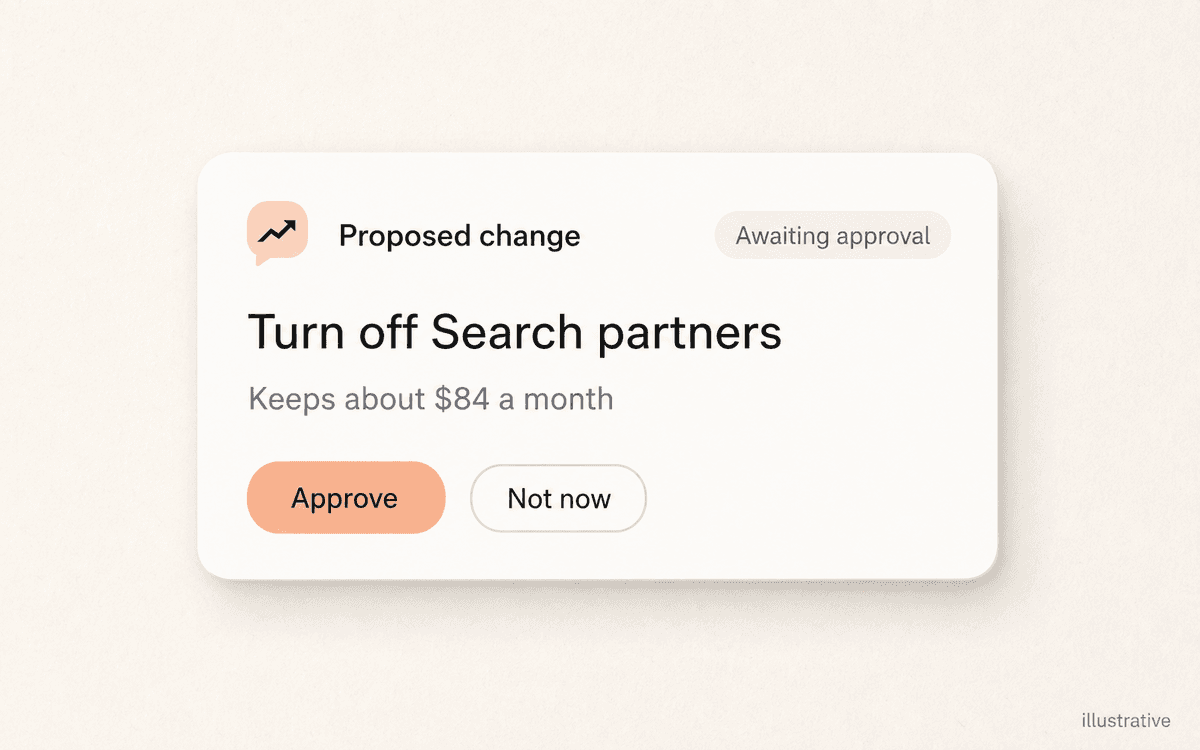
And then it waits. Nothing changes until you say yes. The button says Approve, the other one says Not now, and Not now is a complete answer with no follow-up. If you close the tab, the proposal is still there next week, unapplied.
That is the whole difference: the audit stayed in the room, and the hand on the wheel is yours.
The receipt
Say yes, and the change is applied in your Google Ads account by code, not by a person with a browser tab open. The moment it applies, it writes a receipt: what changed, from what to what, when, and who approved it.
The receipt has one more line, and it is the line that makes the yes possible: undo. One click, and the setting goes back to what it was. Not "we'll look into it", not a support ticket. The same code that made the change knows how to unmake it, because it recorded the before state on the way in.
Undo is not a safety net for our mistakes. It is what makes it reasonable for you to approve a change at eleven at night without a consultant on the phone. You can be wrong for a minute.
Who gets paid when you keep spending
It is worth saying where the money goes in this arrangement, because it explains why the fix button exists at all.
Google earns per click and a retainer scales with your budget, so neither has much reason to suggest spending less. Ours does not scale with your budget, which is the only reason we can say "stop" and mean it.
So if a finding says "pause this", nothing on our side gets smaller when you do. And if the honest reading is that Google Ads is the wrong place for your business right now, nothing stops the answer from saying so.
The honest zero
One more thing an audit never does: admit it cannot tell.
Sometimes the tracking is broken. The account has spend, it has clicks, and it has no idea whether any of them became a customer, because nothing is measuring the customer. Every audit tool in that situation either invents a score or reports a clean bill of health, and both are wrong.
Our scan reports a zero with a note: waste is unmeasurable until tracking works, and here is the spend that is at risk in the meantime. It is a finding. It is arguably the most important one, because everything else is guesswork until it is fixed. The founder's own scan misled the founder once by showing a bare zero, which is how the note came to exist.
The audit should stay in the room
Nothing here requires you to become the person who lives in the cockpit. It requires the diagnosis to come with the treatment, the treatment to wait for your yes, and the yes to be reversible.
Get the list, by all means. Then ask for the fix, look at exactly what it does, and press the button yourself. Keep the receipt.